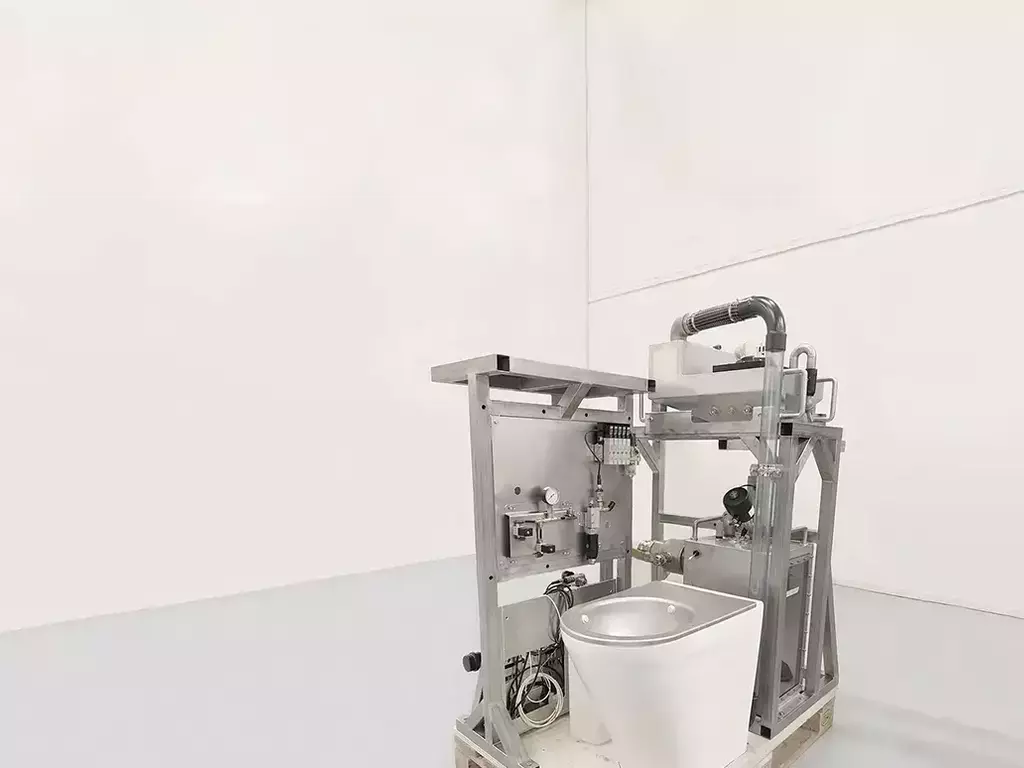
NOAH replaces conventional biological wastewater treatment with a compact electrochemical process that is faster, cleaner, and easier to integrate. Even under variable and intermittent operating conditions. Our patented technology treats wastewater directly at the source, without chemicals, without complex biological reactors, and without greenhouse gas emissions.
Closing the water loop with electrochemistry
A new generation of wastewater treatment
Traditional wastewater treatment depends on biological processes that require large tanks, continuous monitoring and stable operating conditions. These systems are sensitive to load fluctuations, temperature variation and toxic shock. They don't allow intermittent use. They generate greenhouse gasses. They fail to remove phosphorous, micropollutants and bacteria.

NOAH uses electrochemistry instead.
By applying a controlled electrical current, contaminants are removed almost instantly without relying on bacteria or chemical additives. The result is a treatment process that is compact, efficient and predictable.
Benefits
- Instant operation
- Handles variable and intermittent loads
- No biological processes
- No added chemicals
- Water reuse ready
- Low maintenance
- Compact footprint
Electrochemistry vs. Biological Treatment

Comparison table

The patented Tube-in-Tube Reactor
Designed for performance. Built to scale.
At the heart of every NOAH installation is the patented Tube-in-Tube reactor.
Unlike conventional plate reactors, the concentric Tube-in-Tube design creates a uniform electric field across the entire flow path. Wastewater flows continuously through the reactor while contaminants are removed through electrocoagulation.
The result is a reactor that delivers consistent treatment performance while preventing clogging—a major limitation of conventional electrochemical systems.
Because the reactor is compact and modular, manufacturers can integrate it directly into their own products without redesigning their complete system.
From wastewater to reusable water in five steps
1. Influent
Pretreatment and homogeneization of incoming wastewater.
2. Electrocoagulation
An electrical current destabilizes dissolved contaminants, heavy metals and suspended particles, causing them to bind together into removable flocs.
3. Dewatering
Separation and filtration of clear water and sludge.
4. Electro-oxidation
Disinfection & micropollutant removal.
5. Reclaimed Water
Clean water becomes available for reuse or safe discharge, helping close the local water cycle.

Proven treatment performance
NOAH's electrochemical technology has demonstrated excellent removal efficiencies across a broad range of contaminants.
- High-quality effluent suitable for water reuse
- Effective removal of organic pollutants and nutrients
- Built-in pathogen reduction through electrochemical treatment
- Micropollutant removal capability
- Chemical-free treatment process
- Designed for compliance with ISO 30500 and future EU wastewater standards
Technology that grows with your application
NOAH currently offers two scalable sanitation systems built around the same patented reactor technology.
NSS-1000
Ideal for smaller decentralized installations
- Up to 1000 litres/day
- Single households, mobile sanitation, railway, maritime,...

NSS-5000
Designed for larger decentralized projects
- Up to 5000 litres/day
- Temporary sanitation blocks, small communities, new residential developments,...